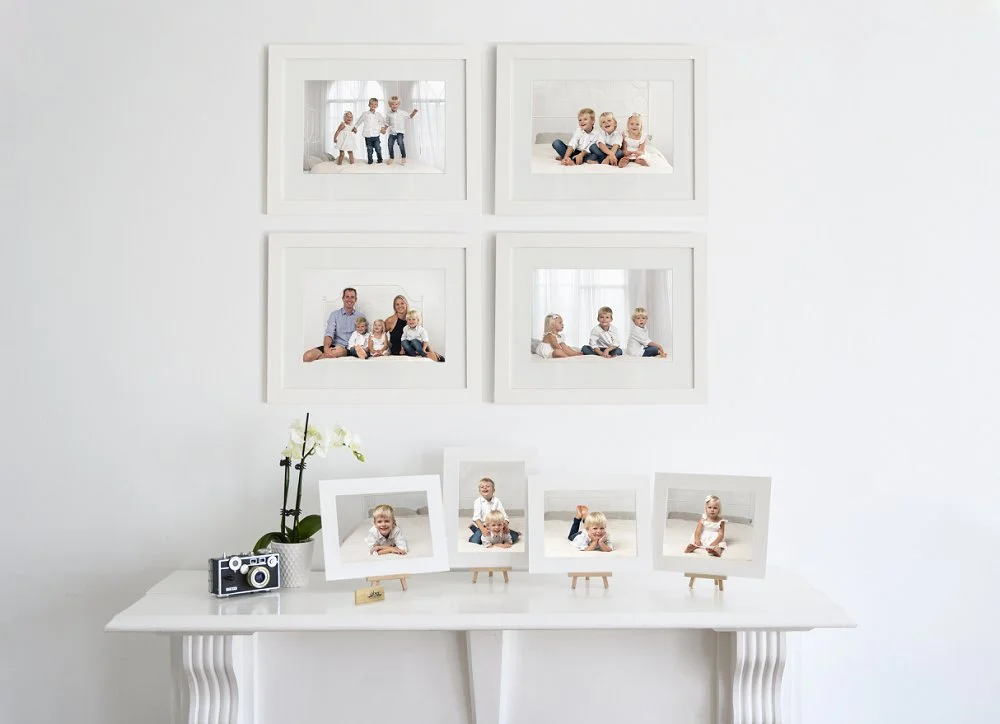
What to Wear for Studio Family Photos
Working out what to wear for family photos is the bit most mums get stuck on. After 23 years photographing families in my Gordon studio on Sydney's North Shore, here's what actually works. Start with mum, coordinate rather than match, and pick a palette before you pick the clothes. Four colour combinations that photograph well, and the short list of things to skip.
What to wear for family photos is the thing most mums get stuck on, usually at 10pm the night before. Outfits change how the photos feel more than almost anything else you can control, so they're worth ten minutes of proper thought. Here's how I'd approach it, after 23 years of doing this and roughly 2,500 families through my studio in Gordon.
Start With Mum, Then Build Around Her
Pick your outfit first. Everyone else coordinates around you.
I say this to every mum who asks, and the reason is simple. You're the one most likely to feel awkward in front of a camera, and if you're not comfortable in what you're wearing, it shows in every single frame. Your kids will be fine. Your husband will be fine. You're the one I want to get right.
So choose something you already own and already love. Something you've worn before and know you look good in. Not the thing you bought last week that you're not quite sure about, and not the thing that only works if you stand a certain way. You'll be sitting on the floor, holding a toddler, leaning into your husband, laughing at something one of your kids has said. Comfortable matters more than clever.
If you're between two options, go with the one that's softer and has a bit of movement in it. Stiff, structured fabric photographs stiff. Fabric that moves reads as relaxed, which is what you want.
I've had mums turn up with three outfits in a bag because they couldn't decide. Nine times out of ten we go with the one she's worn before and already knows she feels good in.
Takeaway: choose yours first, build everyone else around it.
Think of the Whole Family as One Outfit
Coordinated, not matching. There's a big difference.
Matching outfits, everyone in white shirts and jeans, means everyone blends into everyone else. You lose the individual people. What you actually want is a family that clearly belongs together but where each person still looks like themselves.
The test I use is this. If every item of clothing you've chosen was somehow on one person, would that outfit work? If the answer is yes, you've got it. If it's a mess, something needs to change.
In practice that means picking two or three colours plus a neutral, then varying the tone within them. One person in a deeper shade, another in a lighter one. Let one person wear a pattern if they want to, then keep everyone else fairly plain so the pattern doesn't have to compete.
Texture is your friend, especially in the studio. Knits, linen, denim, corduroy. They give the images depth without adding visual noise. A chunky jumper does more for a photo than a busy print does.
Have a look through my family portrait gallery and you'll see the same principle in most of them. Nobody matches. Everybody goes together.
Takeaway: if it would work as one outfit, it'll work as a family.
Four Colour Palettes That Work in the Studio
My studio light is controlled, which means colours behave predictably. These four are the ones I come back to.
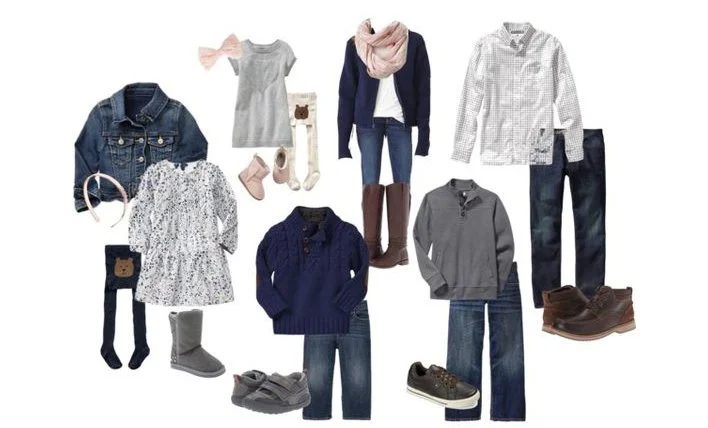
Blues and greys. Endlessly versatile and easy to shop for from what's already in the wardrobe. Mix the shades rather than using one flat blue across everyone, and throw in one small hit of a different colour if you want some lift.
Neutrals. Creams, oatmeal, tan, soft white, warm beige. This palette gives a very natural, calm feel and it's lovely if you want to put the little girls in something floral. It also ages well, which matters if the photos are going on the wall for the next fifteen years.
Black and grey. Black is flattering and a lot of parents feel more confident in it, so I'd never tell you to avoid it. It works particularly well in the studio where I can control the light and keep the shapes separate. Add grey and white for the kids so you're not looking at one solid block of dark.
Your own palette. Pick any three or four colours you actually like and coordinate around them. Cohesive without being matchy. Nobody standing out more than anyone else.
Takeaway: pick a palette before you pick the clothes.
Blues and greys
What to Skip
A short list, because there really aren't many rules.
Big logos and slogans. A small logo on a pocket is fine. What I mean is the brand name running right across the chest, or the slogan T-shirt. Your eye goes straight to the writing instead of the faces, and in ten years the logo will date the photo more than anything else in it.
Loud character prints. Your five-year-old loves that dinosaur shirt. I understand. But a big cartoon print pulls focus off your child's face, which is the whole reason you're here.
Anything brand new and untested. New clothes are stiff, sometimes itchy, and nobody knows yet whether they're comfortable. A child tugging at a scratchy collar for an hour is not a good look for anyone.
Too many competing patterns. One pattern in a group is interesting. Four patterns is busy.
Very bright single colours in large amounts. Strong fluoro or saturated brights can throw colour up onto skin under studio lighting. Fine in small doses, tricky as a whole outfit.
Takeaway: anything that pulls attention away from faces is the thing to change.
The Practical Bits Nobody Thinks About
Lay everything out two or three days before, not the night before. This is the single thing that reduces stress most and it costs you nothing. You'll spot the missing button, the stain or the pair of trousers that no longer fit while there's still time to do something about it.
Bare feet are my default in the studio. It means shoes are one less thing to organise, and bare feet look softer and more natural than socks or school shoes.
Bring a spare top for yourself if you're torn. It takes two minutes to change and you'll feel better knowing there's an option.
Hair the way you normally wear it, not a style you've never tried before. And take the hair ties off your wrists, they turn up in more photos than you'd think.
If your dog is coming, and dogs are genuinely welcome here, give them a brush beforehand and swap a bulky harness for a plain collar or nothing at all. They photograph better without a lead across the frame.
One last thing. All of the above is for studio sessions. If you're booked for an outdoor session, the advice shifts a fair bit, mostly around layers, footwear and the fact that you'll be sitting on grass.
Takeaway: sort it early and the day itself becomes easy.
And If You're Still Not Sure
Whether you've got a newborn, three kids under ten or teenagers who need bribing to be there, the same approach works. Get the outfits decided early, then turn up and let me handle the rest. Nobody has ever failed a family session on clothing.
I photograph families at every stage. If you've been thinking about booking a session, now is the time. You can see what's included and what families usually spend on my pricing page, or just send me a message and tell me what you're thinking.
Kate x

How to Choose the Right Family Photographer: 5 Questions You Should Ask Before Booking
If you’re looking for a family photographer , take the time to ask any potential photographers these five questions—you want to make sure they answer all your questions and concerns before your session, so when you arrive for your session you can relax and enjoy the experience of having your family photographed.
Most families put enormous effort into choosing a wedding photographer but barely think about who will photograph their family. And yet family photos are the images your children will grow up looking at. They are the ones your grandchildren will find one day and hold onto. They are, in many ways, more important than wedding photos because they document the people your family became after the wedding was over.
If you are looking for a family photographer, especially in Sydney, do not just book the first person who comes up on Google. Take the time to ask these five questions. They will tell you everything you need to know about whether a photographer is the right fit for your family.
1. How Many Years of Experience Do You Have with Families?
Experience matters in family photography in a way it does not always matter in other types of photography. A good landscape photographer can wait for the perfect light. A good family photographer has to work with a toddler who has just had enough, a teenager who does not want to be there and a dog who has decided to sit on the backdrop.
Ask specifically about family experience, not just photography experience generally. A photographer might have beautiful work in their portfolio but if most of it is weddings or commercial work, they may not know how to handle the unpredictability of photographing children.
I have been photographing families for over 23 years from my studio in Gordon on Sydney's North Shore. In that time, I have worked with roughly 2,500 families. I have photographed newborns who screamed for the first 20 minutes and then fell asleep perfectly. I have worked with teenagers who arrived refusing to smile and left laughing. I have had dogs steal entire sessions in the best possible way. Experience with families specifically is what makes the difference between a stressful session and a relaxed one.
Look at their portfolio carefully. Are the images consistent in quality? Do the families look relaxed or stiff? Can you see real expressions or does everything look posed? The portfolio tells you more than the number of years ever will.
2. What Is Their Style, and Does It Match What You Want?
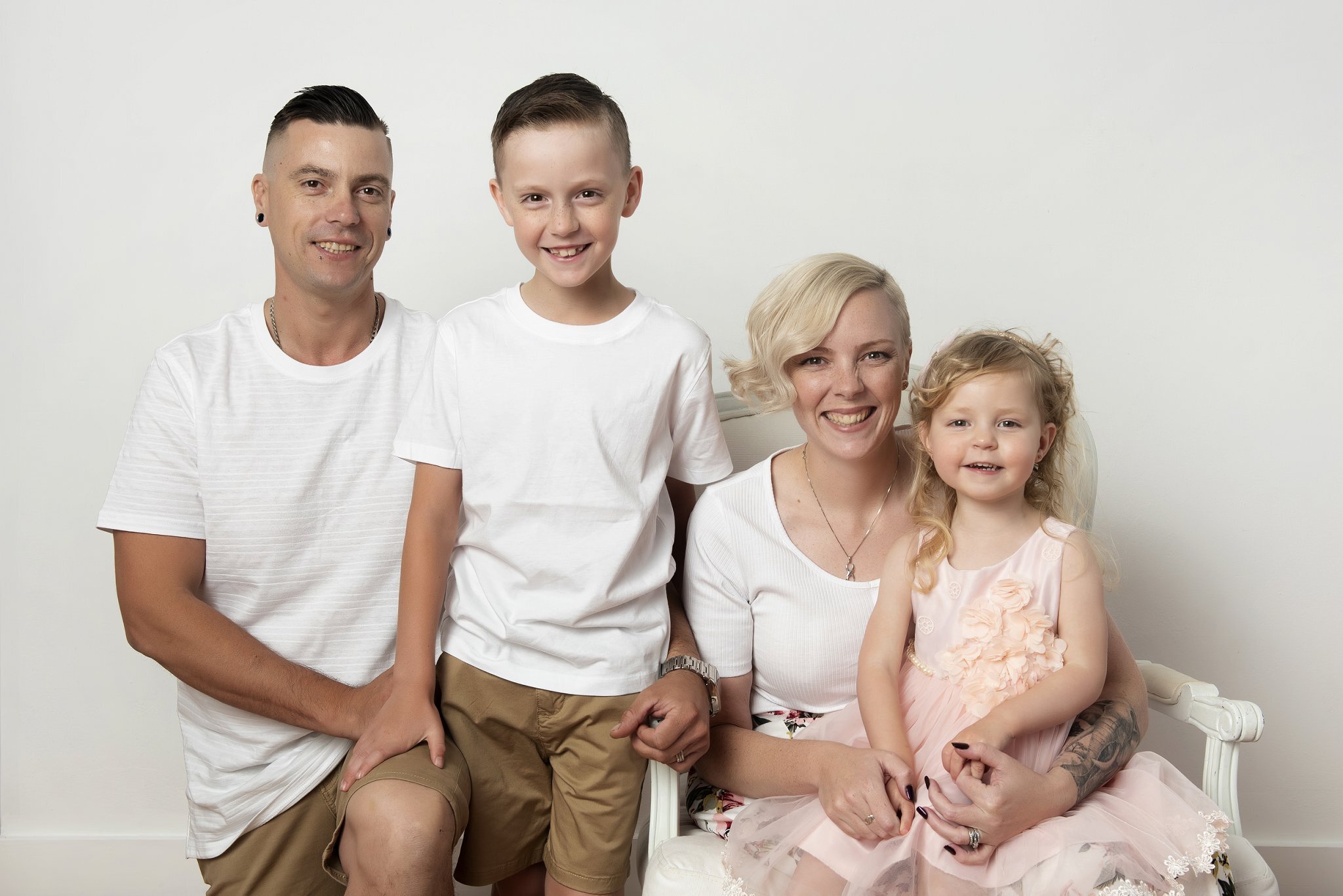
Not all family photographers shoot the same way. Some specialise in posed, structured portraits. Some work in a purely candid, documentary style. Some, like me, do both depending on what the family wants.
Before you book, look at their work and ask yourself: do these photos look like my family? If you have young kids and a dog, and every image in the photographer's portfolio shows perfectly posed adults in a studio, that might not be the right fit. If you want natural, relaxed images and the photographer's work looks stiff and formal, keep looking.
It is also worth asking whether they specialise in a particular type of family photography. Some photographers primarily photograph newborns and may not have much experience with older children or teenagers. If your kids are 12 and 15, you want someone who is comfortable working with that age group and knows how to make teenagers feel at ease, which is a skill in itself.
Do not be afraid to ask for specific examples. A good photographer will be happy to show you sessions that are similar to your family's situation.

3. Do They Have Repeat Clients?
This is one of the strongest indicators of a good family photographer. If families come back year after year, it tells you three things: the quality of the work is consistent, the experience is enjoyable, and the photographer has built genuine relationships with their clients.
Ask the photographer directly. How many of your clients come back? Do you photograph the same families at different stages? A photographer who has followed families from newborn through to school photos through to teenagers is someone who understands how families change and how to photograph them at every stage.
I have families who have been coming to me for over 15 years. I have photographed their newborns and now I am photographing those same kids as teenagers. That continuity matters because I know these families. I know which child is shy. I know which parent hates being in photos. I know the dog's name. That familiarity makes every session easier and the photos better.
Check their Google reviews. Real reviews from real clients will tell you what the experience is actually like, not just what the photos look like. If every single review is five stars with no detail, look a little closer. No business has 100% happy clients all of the time. An occasional less-than-perfect review with a thoughtful response from the photographer is actually a good sign. It means the reviews are genuine.

4. What Is Their Cancellation and Rescheduling Policy?
Kids get sick. It is not a matter of if, it is when. And it always seems to happen the night before a session you have been looking forward to for weeks.
Before you book, ask about their cancellation and rescheduling policy. Can you reschedule if your child wakes up with a temperature? Is there a fee? How much notice do they need? A family photographer who works with young children should understand that illness is part of the deal and have a flexible policy that accounts for it.
I reschedule for sick kids without any fuss. I would rather your family come in when everyone is feeling well and happy than push through a session where a child is unwell and miserable. The photos will be better for it, and you will enjoy the experience instead of surviving it.

5. Do They Have Experience with Your Family's Specific Needs?
Every family is different, and some families have needs that require a photographer with specific experience or sensitivity. You might have a child with additional needs who finds new environments overwhelming. You might have a child with a physical disability that requires modified posing. You might have a blended family with complex dynamics. You might have a child who is going through a tough time and is resistant to being photographed at all.
Whatever your situation, ask the photographer directly. Have you worked with a family like ours before? How would you handle this? The answer will tell you a lot. You are not looking for someone who has done it a hundred times, although that helps. You are looking for someone who listens, who is genuinely compassionate and who is willing to work with your family rather than trying to fit you into a standard session format.
In my studio, I adapt every session to the family in front of me. No two sessions look the same because no two families are the same. If your child needs extra time to warm up, we take extra time. If your teenager needs space, I give them space. If your dog needs to be part of every single frame, that is what we do. The session works around your family, not the other way around.

The Right Photographer Makes All the Difference
Choosing a family photographer is not just about finding someone who takes nice photos. It is about finding someone you trust, someone your family feels comfortable with and someone who understands that the best family photos come from genuine connection, not perfect posing.
Take the time to ask these questions. Look at the work. Read the reviews. And when you find someone who feels right, book the session. Because the photos you take of your family now are the ones you will treasure most in 20 years.
If you are on Sydney's North Shore and looking for a family photographer who genuinely loves working with real families, dogs and all, I would love to hear from you.
Kate x

5 Tips for Better Photos of Your Kids (No Fancy Camera Required)
Most parents think they need a better camera to take better photos. I hear it all the time. "I would take more photos but my phone camera is not great." Here is the thing: the camera on your phone is fine. More than fine, actually. As a photographer with over 23 years of experience, I can tell you that your best camera is the one you know how to use. So instead of worrying about equipment, get to know the features on your phone and learn how to use the light, the setting and your child's personality to your advantage.
These are my five tips for taking better photos of your kids at home, and not one of them requires you to spend a cent.
Choose the Time of Day Wisely
This is the single biggest thing you can do to improve your photos. Harsh midday light creates hard shadows on faces, and it is genuinely unpleasant to have your photo taken when the sun is shining directly at you. Adults squint. Kids squint worse, or they just close their eyes entirely. The result is a phone full of photos where nobody looks comfortable.
The best light for photos is early in the morning or late in the evening. Photographers call these the golden hours. Shortly after sunrise or just before sunset, the sun sits at its lowest point in the sky, which creates softer, warmer light. The shadows are gentle, the colours are beautiful and your kids are not screwing up their faces trying to look at you.
I know what you are thinking. At those times you are either making breakfast or doing the bath and bedtime routine. Fair enough. That leads me to the next tip.
Shade and Cloud Cover Are Your Best Friends
A cloudy day might be a bride's nightmare, but for a photographer it is often preferred. Clouds act like a natural diffuser, softening the sunlight so it wraps around faces evenly instead of creating harsh shadows. If the sky is clear, find a nice open shady spot instead. Under a tree, on a covered porch, or even just the shaded side of your house.
One thing to watch for in shade is dappled light. Those little speckles of sun that seep through branches look lovely in person but create uneven patches across faces in photos. If you can see spots of bright light on the ground where you are standing, move to a spot where the shade is more even.
As a mum of three, some of my favourite photos of my kids were taken on overcast days in the backyard. The light was flat and even, the kids were relaxed, and I did not have to wrestle with shadows or squinting.
Keep the Background Simple
Everyone loves that blurry background effect where the subject stands out and everything behind them is soft. That is called shallow depth of field, and it is hard to achieve on a phone camera. But the reason we love it is not actually the blur itself. It is that the person in the photo stands out clearly from their surroundings.
You can get a similar effect by choosing a simple, uncluttered background. A green hedge, a plain wall, open sky at the beach, or a stretch of grass at the park. The less visual noise behind your child, the more they become the focus of the image.
Avoid taking photos in front of cluttered shelves, busy playgrounds or car parks. Even a beautiful park can produce a messy photo if there are bins, signs and other people directly behind your child. Take a second to look at what is behind them before you press the shutter. Move a step to the left or right and the background can change completely.
Do Not Say Cheese
This is probably my favourite tip because it is the one every parent instinctively does. You hold up the phone and say "say cheese!" and your child clamps their top and bottom teeth together in a forced grimace that looks nothing like their actual smile.
Instead, try asking them to say something silly. "Stinky undies" works almost every time. "Smelly socks." "Poo bum." Whatever makes your particular child laugh. The goal is to get a genuine reaction, not a posed one.
With younger kids, I find that making a silly noise or pretending to sneeze works better than asking them to say anything at all. With older kids and teenagers, asking them to think about something funny that happened recently can produce a real smile. The key is that the expression needs to come from a real moment, not from an instruction.
After 23 years of photographing kids, I can tell you that the difference between a forced smile and a real one is immediately obvious in a photo. And the real one is always the one that ends up on the wall.
Let Them Be Themselves
This is the tip that most parents find hardest. We want a nice photo, so we try to pose our kids. Stand here. Look at me. Hold still. Arms down. Smile. And the result is a stiff, awkward image that does not capture who your child actually is.
The best photos of children are almost always candid. Let siblings tickle each other. Let them dance. Ask them about their favourite movie or what happened at school that day. When a child is doing something they love or talking about something that excites them, their face lights up in a way that no amount of posing can replicate.
Some of my most treasured personal photos of my own kids are the ones where they had no idea I was even taking a photo. Running through the sprinkler. Laughing at each other over breakfast. Reading a book with the dog. Those are the images that capture who they are at this stage, and those are the ones I am most grateful for.
The Real Secret
The best photos are not about the camera, the lens or the lighting. They are about connection. If your child feels relaxed, comfortable and happy, it will show in the photo. If they feel pressured, bored or annoyed, that will show too.
So put down the stress about equipment. Use the camera you have. Find some nice light. Keep the background simple. Make them laugh instead of making them pose. And take lots of photos, because the more you take, the more likely you are to catch that one perfect moment.
And if you want photos that go beyond what your phone can do, that is where I come in. A family session at my studio in Gordon is relaxed, natural and designed to capture your family exactly as you are. No forced smiles. No awkward posing. Just your family being yourselves.
Kate x

Why Are Digital Files So Expensive from a Professional Photographer?
Why do professional photographers charge so much for their digital files?
Why Are Digital Files So Expensive from a Professional Photographer?
One of the most common questions I get asked is why digital files cost so much. It is a fair question. In a world where we take hundreds of photos on our phones every week, it can feel strange to pay a significant amount for a set of digital images. But there is a good reason, and it comes down to one simple question: what are you actually going to do with those files?
The Honest Truth About Digital Files
I have been a family photographer for over 23 years, and I can tell you what happens with digital files in most families. They get downloaded onto a computer or a hard drive. They sit there. The parents mean to print them, but life gets in the way. Then a year passes, then two, then five. Sometimes the hard drive fails. Sometimes the files get lost in a phone upgrade. And those beautiful photos from that session you invested in? Gone.
I have seen it happen too many times. As a mum of three, I know exactly how it goes. You have the best intentions to print photos, put together albums, fill in baby books. But the reality is that life with kids is relentless, and printing photos always falls to the bottom of the list.
What You Are Really Paying For
When you purchase digital files from a professional photographer, you are paying for full print rights. That means you can print those images as many times as you like, wherever you like. In theory, that sounds like great value. But if you are honest with yourself about whether you will actually print them, the value changes.
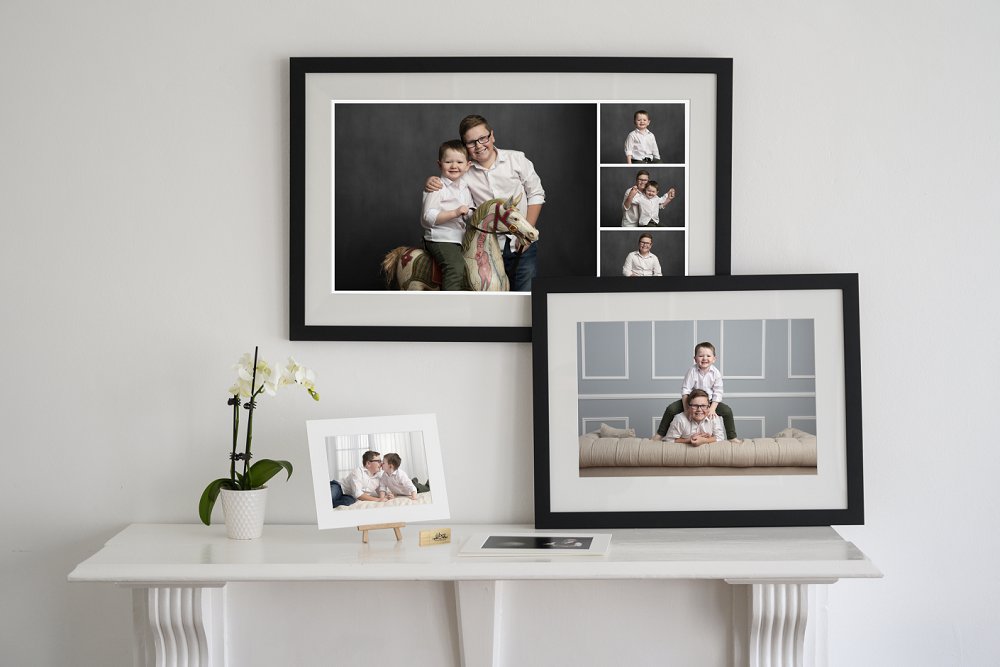
Compare that to having your photographer handle the printing for you. I use archival-quality paper and archival framing materials, which means the prints and frames I produce will last your family a lifetime. The mat boards, the glues, the paper, everything is designed to stand the test of time. If you print at a retail lab or online service, you do not get that same quality or longevity.
Why Printed Photos Are Worth the Investment
There is something about a printed photo on your wall that a file on a hard drive will never give you. Your family sees it every single day. Your kids grow up walking past it. It becomes part of your home, part of your story. A digital file sitting in a folder does none of that.
I help my clients choose the right sizes and layouts for their walls. If you bring me photos of the rooms where you want to display your portraits, I can guide you on what will work best in the space. That is part of the service, and it is something you do not get when you walk away with a USB stick and figure it out on your own.
The Bottom Line
Digital files are not a bad option. But they are only valuable if you are genuinely going to do something with them. If you know in your heart that they will end up sitting on a hard drive untouched, then investing in beautifully printed and framed portraits is a far better use of your money. You will enjoy them every day, and they will last for generations.
If you are not sure which option is right for you, get in touch and I can walk you through what will work best for your family and your home.
Kate x