

Can You Bring Your Dog to a Family Photo Shoot?
Yes, your dog can come to a family photo shoot in Sydney. Here's how it works at my Gordon studio, where about a third of sessions include a dog.
Yes, you can bring your dog to a family photo session in Sydney, and at my studio the dog is part of the family, not an add-on or a problem to manage. I'm Kate Buechner, I've photographed roughly 2,500 Sydney families over 23 years, and about a third of my sessions have a dog in them. If you've been wondering whether your dog can come, this post tells you exactly how it works and why it goes better than you think.
So, can the dog actually come?
Short answer, yes, and I'd encourage it. If the dog is part of your family, the dog belongs in the photos. About 30 per cent of the families I photograph bring a dog, so this is normal here, not a special request I have to think twice about.
The reason it works comes down to the space. My studio in Gordon is a 175sqm room with three big arch windows, and it's set up to feel like a home, not a clinic. That size matters more than people realise. It means I can take your dog off the lead and let them actually be a dog. There's room to move, room to sniff about, room to settle. A small studio can't do that, which is why a lot of photographers quietly steer you away from bringing the dog at all.
So the question isn't really "will you allow my dog". It's "is your space set up for it". Mine is, and it's been set up for it for years.
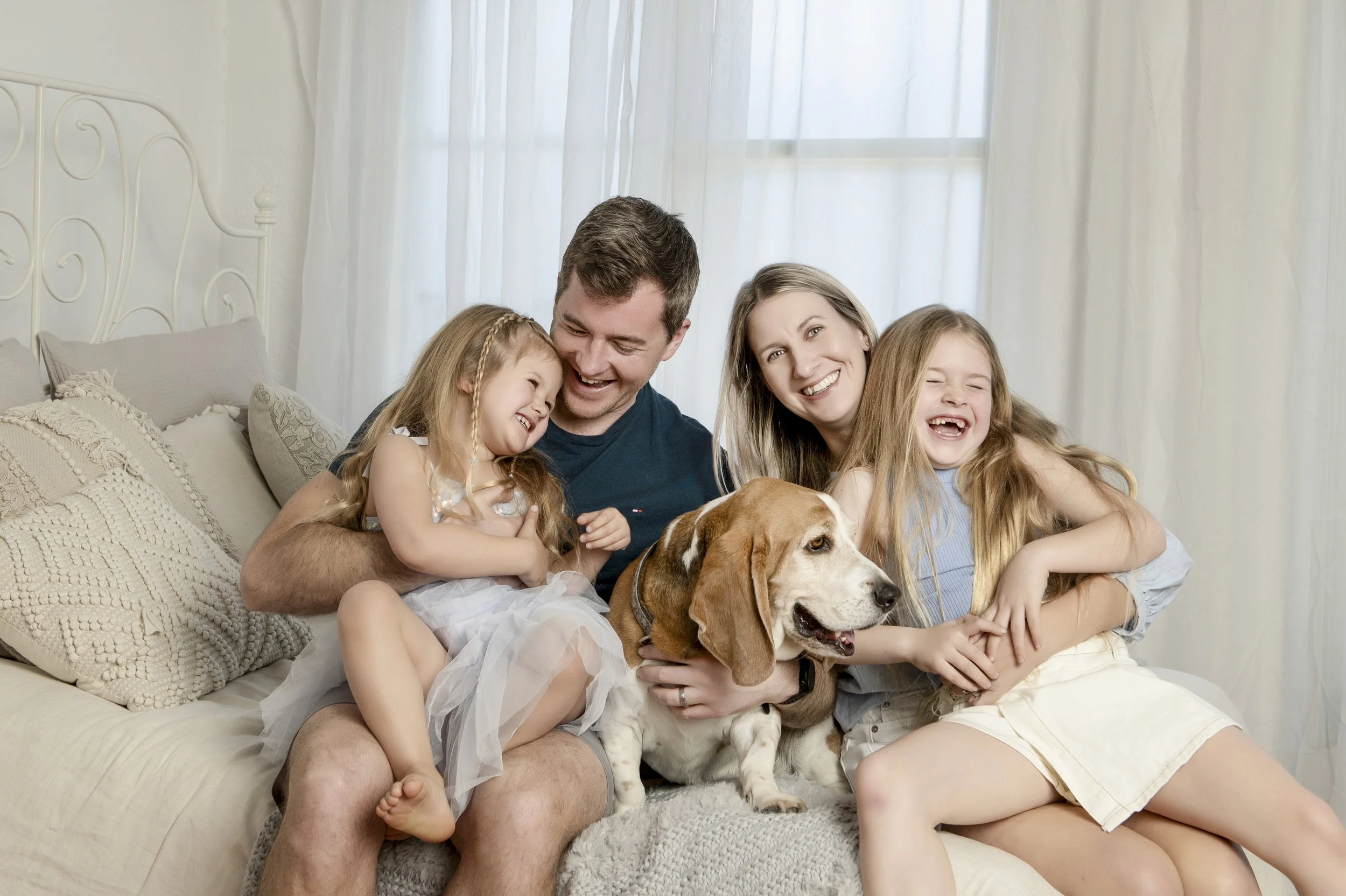
But my dog won't behave. They'll never sit still for photos.
This is the worry I hear most, and I understand it. You picture your dog ignoring every command, bolting around the room, refusing to look at the camera while you stand there apologising. It almost never goes that way.
Here's what actually happens. The dog comes in, has a good sniff around, usually jumps straight up on the bed or the lounge, and within a few minutes settles right down. I never start shooting the second you walk in. I give the dog time to get used to the space first, because a relaxed dog photographs beautifully and a rushed one doesn't. By the time I begin, your dog isn't on edge anymore. They're at home.
It helps that I love dogs. I've got my own miniature dachshund, Lollie, so working with dogs isn't a service I tolerate, it's something I look forward to. Dogs read that. They sense when someone's comfortable with them, and they relax accordingly. The takeaway here is simple. You don't need a perfectly trained dog. You need a space and a photographer that work with the dog you've actually got.
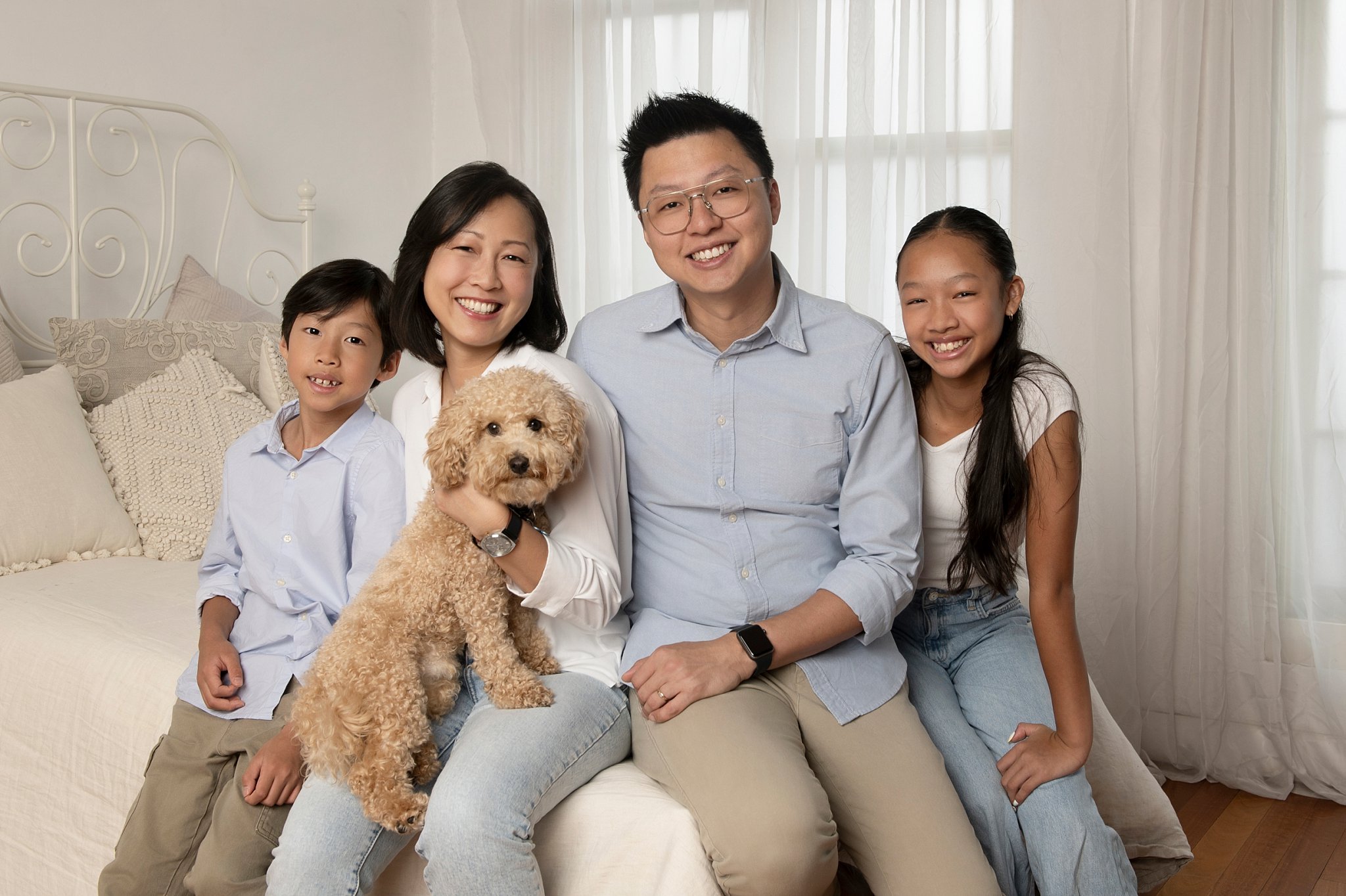
How do you even get the dog in the photo?
The other worry, right behind behaviour. People imagine the dog will be off in a corner while the family poses, and they'll end up with photos that don't include the one they came for.
What really happens is the dog usually steals the show. I tend to put the dog right in the centre of the family, and nine times out of ten they love being the centre of attention. You'd be amazed how many of my favourite family images come down to a dog doing a head tilt at exactly the right moment. It's the best thing ever, and it's the frame the whole family ends up wanting on the wall.
One thing I do that not everyone does, I'll also photograph your dog on their own. Not just tucked into the family group, but proper portraits of the dog by themselves, so you've got something beautiful of them to keep. Dogs don't stay with us as long as we'd like, and a real portrait of yours, the way you actually see them, is worth having. That's the bit families tell me later they're most glad they got.
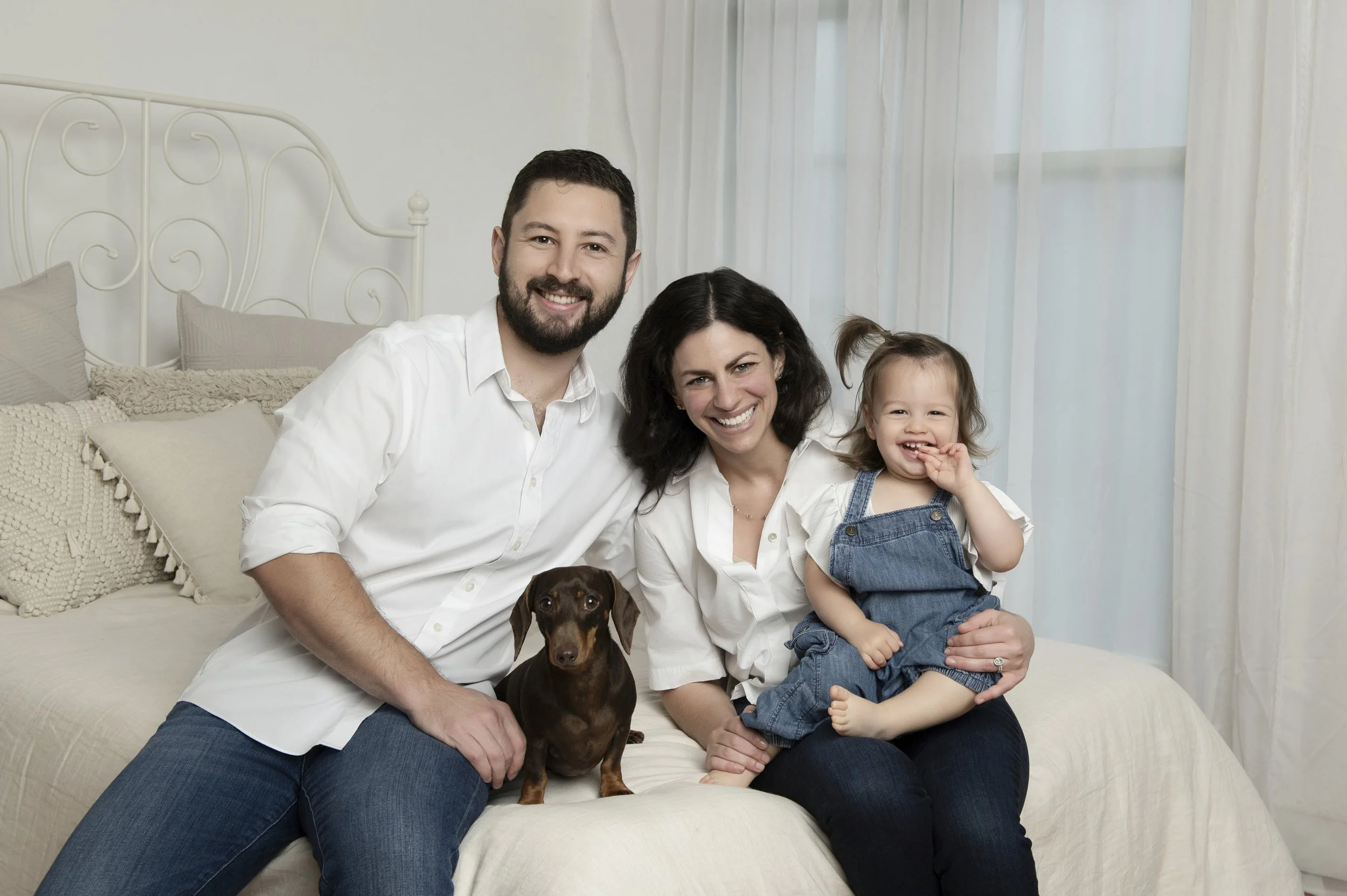
What you'll walk away with
When a dog comes to a session here, you don't get a stiff family line-up with a dog awkwardly bolted on the end. You get your family as you actually are, dog included, relaxed and real, plus a few portraits of the dog on their own that you'll be glad you have down the track. That's the whole point of how I work. Real families, real moments, dog very much welcome.
Whether your family is two people and a puppy or a full house of kids and a dog who thinks they're a kid too, that's worth photographing exactly as it is right now. If you've got a dog you want in the frame, have a look at my Dogs and Their Families gallery or send me a message and let's talk about a session.
Kate x

Are You Really Present with Your Children?
How often are you fully and completely present when you are with your children? One of the greatest gifts we can give to our children is to be fully present with them. In the times we live in, this can often be a big challenge.
Are You Really Present with Your Children?
How often are you fully present when you are with your kids? Not just in the same room. Not just supervising homework while scrolling your phone. Actually present. Listening. Engaged. Focused entirely on them.
If you are honest with yourself, it is probably less often than you would like. And that is not a criticism. It is just the reality of being a parent in a world that never stops demanding your attention.
I have three kids. When they were little, I was running my photography business full time, managing a household and trying to be a decent partner on top of it all. There were days when I felt like I was everywhere and nowhere at the same time. Physically present but mentally running through tomorrow's to-do list while my child was trying to tell me something about their day.
It took me a while to realise that being in the room is not the same as being present. And that the difference matters more than I thought.
What "Being Present" Actually Looks Like
For me, the only way to genuinely be present with my kids was to create what I called "time alone" with each of them. Not family time where everyone is together and chaos reigns. Individual, one-on-one time where I did whatever they wanted to do.
During that time, I did not answer the phone. I did not fold laundry or empty the dishwasher. I did not think about client emails or what was for dinner. It was their time, and they had my full attention.
Some days it was half an hour. Some days it was longer. The length mattered less than the quality. What mattered was that for that window of time, my child knew they were the most important thing in my world.
What Happens When Kids Do Not Get Your Full Attention
Children are perceptive. They know when you are distracted. They know when you are half-listening. And they interpret it in a way that is hard to hear: they think they are not important to you.
That is not what you mean, of course. You are distracted because you have a hundred things to do and not enough hours. But your child does not see your to-do list. They see a parent who keeps looking at their phone, who answers every call, who says "in a minute" and then forgets.
When kids do not get focused attention, they find other ways to get it. Some chatter nonstop, trying to hold your attention by sheer volume. Some act out, fighting with siblings or pushing back on chores, homework and bedtime. Some go quiet and stop trying altogether. None of these are bad behaviour. They are a child communicating a need the only way they know how.
My Own Experience Growing Up
My mum was always busy when I was a kid. She was juggling three children and working part time, and it felt like she never had time to just be with me. She never asked about my thoughts or feelings, or how things were going at school. She never played with me or just hung out with me.
I do not say that to criticise her. She was doing her best with what she had. But I remember how it felt. And when I became a mum, I was determined to do it differently. That is where the "time alone" idea came from. I did not want my kids to grow up feeling like they were not important enough for me to stop and pay attention.
It Gets Harder as They Get Older
When your kids are little, they want your attention constantly. The challenge is finding the energy to give it. But as they get older, the dynamic shifts. My kids are busy now with their own friends, schoolwork and screens. There are days where I am the one trying to get their attention, not the other way around.
This is where the habits you build when they are young pay off. If your child has always had that one-on-one time with you, they are more likely to keep talking to you as teenagers. Not about everything. But about enough. The connection you build in those early years becomes the foundation for the relationship you have with them later.
Think About How It Feels When Someone Really Listens to You
When was the last time someone gave you their complete attention? Looked you in the eyes, listened to what you were saying, and did not check their phone or look over your shoulder? It feels incredible, does it not? It feels like you matter.
Now think about how rarely that happens in everyday life. Most conversations are half-attention at best. We are all guilty of it.
Your child feels the same way you do when someone truly listens. And they feel the same way you do when someone does not.
You Do Not Need to Be Perfect
This is not about guilt. Nobody can be fully present every minute of every day. You have a life to run, meals to cook, a house to manage and probably a job on top of that. The goal is not perfection. The goal is intention.
Thirty minutes a day of genuine, focused, one-on-one time with your child is enough. Put the phone in another room. Turn off the television. Sit with them and do whatever they want to do. Ask them questions and actually listen to the answers. Let them lead.
It does not have to be elaborate. It can be a walk around the block. Drawing together. Kicking a ball in the backyard. Lying on the couch while they tell you about a game they are playing. The activity does not matter. Your attention does.
They Grow Up Fast
I know this sounds like a cliché, but it is true in a way that only hits you when it is happening. One day you are settling a newborn at 2am and the next you are dropping a teenager at a party and hoping they text you when they want to be picked up.
The version of your child that exists right now will not exist for long. The things they are excited about, the way they laugh, the stories they tell you at bedtime. All of it is temporary. And the only way to hold onto it is to actually be there for it.
You have an opportunity every single day to give your child something that costs nothing and means everything. Your full, undivided attention. Even if it is just for half an hour.
Do not miss it.
Kate x


How to Create "Me Time" When You're a Busy Mum
Life with kids goes past in a blur... As a mum I wanted to share some simple tips that could help you find a little more time for yourself.
If you are anything like me, you have probably forgotten what it feels like to do something just for yourself. Between school runs, work, cooking, cleaning and making sure everyone else is happy, your own needs end up at the very bottom of the list. And at some point, you stop noticing they are even there.
I get it. I have three kids, and there were years where I could not tell you the last time I sat down with a book or went for a walk on my own. Everything revolved around everyone else. But here is what I have learned: you cannot pour from an empty cup, and taking time for yourself is not selfish. It is necessary.
Start with 30 Minutes a Day
That is it. Thirty minutes. Read a book. Go for a walk. Meet a friend for coffee. Have a nap. Yes, I said it. A nap. Whatever you want to do with those 30 minutes is entirely up to you.
This might mean the laundry does not get folded straight away. The groceries might wait an extra hour. But does it affect anyone? Does it hurt anyone? Not at all. If your baby is safe, fed and loved, you are doing your job.
This does mean working as a team with your partner. And for the record, this is not just about mums. Dads need a break too. Working together on this can genuinely change the dynamic at home.
Meal Prep to Buy Yourself Time
Dinner is one of the biggest time drains. You collect the kids, get home, cook, feed everyone, do bath time, story time, bedtime, then clean the kitchen. By the time you sit down, it is your bedtime too.
Meal prep changes this. Pick a day, maybe Sunday, and cook a few meals for the week. Get the kids involved, or do it with your partner or a friend. Pop the meals in the freezer and you have just bought yourself time during the week. Time to spend with the kids without rushing, time for yourself, or time to just sit on the couch with your family and do absolutely nothing.
Get the Kids Involved in the Housework
The laundry is never going to go away, so you might as well make it work for you. Depending on how old your kids are, turn it into a game. Little ones can match sock colours and line them up on the couch. It is colour practice for toddlers and a bit of bonding time for you.
Toy clean-up works the same way. Create a chart or a whiteboard. If your child picks up all their toys and puts them back in the right spots, they get a mark. Five days in a row and they earn something special on Saturday. A matchbox car, a trip to their favourite park, their favourite dinner, or movie night with popcorn. Positive reinforcement helps them build good habits and gives you a bit of breathing room in your routine.
You Matter Too
There will always be a way to create more time in your day if you look for it. And there is no need to feel guilty about taking it. You are human. You matter. And you are doing a great job.
Kate x

Postnatal Depression and Anxiety: One Mum's Story
Hey mums, why is pre and post natal anxiety, something that we don't talk about? It's so common, & we should be chatting to other mums about it so we can help each other out. This is Sarah, a mum of 2 boys, story of her struggle with this, and how she overcame it.
Why is this something we never talk about? The number of women that go through it, and you only hear about it after you reluctantly say something to a friend, or even a stranger. And often after the worst of it has passed and you are coming out the other side.
I remember finding out I was pregnant with my second, and if I am completely honest, I felt so much guilt because I was not happy to be pregnant. I wondered if I had made a mistake, and it felt awful inside that I might not actually want my baby.
I then started to get really sick. I was three months pregnant and was skin and bone as they investigated what was wrong with me. In the end, I was diagnosed with an autoimmune disease. My feelings totally flipped around. I realised how much I wanted my baby. I was terrified about whether he would be okay. I was told to take medications that can cause birth defects, but was informed by my doctors that if I did not get better and look after myself, it would be worse for my unborn child.
In the end, I gave birth to a perfectly healthy baby boy. I was loving every moment. I had forgotten the newborn touch and smell. I was taking everything in and able to enjoy it the second time around, as I was not filled with the fear and unknown of a first-time mum. But as the months went by, I found myself getting lost in dark thoughts. I would sit in my room feeding and just crying, and not sure why. I never spoke to anyone about how I felt and was confused as to why I felt like I did.
I found myself going to the feeding clinics at the community centre, even though I had no issues feeding. I would find myself crying when the community nurse told me I was doing a great job. I guess this raised some alarm bells with her, so she asked me to come in for an appointment where they get you to answer a questionnaire. I do not think I was completely honest in it, but even still, I was recording levels of depression.
One night, confused and feeling alone and unable to sleep, I took a whole sleeve of anti-anxiety medication. I did not have the intention of self-harm but just wanted to sleep. However, when I look back, I did also know that what I was doing was not good.
I then decided that to get better, I had to talk. I told my psychologist, who I had started seeing towards the end of my pregnancy, and I had never talked to her about my feelings. I had previously only spoken about the children and dealing with trivial daily things. I had the community nurse ring my husband and GP, telling them what was going on, so I could no longer hide it. And had I not started to open up, the healing process may never have started.
It is so important to know that you are not alone. You are never alone. Even if you do not want to seek help from those you are close to, seek it from other places such as helplines and medical practitioners.
Sarah, mum to two boys, Harrison and Hugo

If you think this could be you, please reach out for support.
Lifeline (24 hours, 7 days) 13 11 14 www.lifeline.org.au
PANDA (Perinatal Anxiety & Depression Australia) 1300 726 306 Monday to Friday 9am – 7.30pm, Saturday 9am – 4pm (AEST/AEDT) www.panda.org.au
Healthdirect Mental Health Helplines www.healthdirect.gov.au/mental-health-helplines