

5 things I wish I knew when I was pregnant
Your first pregnancy is such an emotional and scary time. Your body is changing, your life is changing, and most women really don't know what to expect. As a mum of 3, this is my guide to the 5 things that I wish I knew when I was pregnant with my first baby.
When I found out I was pregnant for the first time, I thought I was prepared. I had read the books, talked to friends and done all the research. But there were things that nobody told me, or that I did not truly understand until I lived through them. Now, after three babies and 23 years of photographing newborns and pregnant mums, these are the five things I wish someone had told me honestly before my first baby arrived.
Labour Is Not What You Think It Is
I remember one of the first things I felt when I found out I was pregnant was fear about labour. I had seen it in films and television shows where it is always this dramatic, screaming, chaotic event. Rushed to hospital. Lots of yelling. Total panic.
I am not going to tell you labour does not hurt, because it absolutely does. But my experience, and I think most women's experience, is nothing like what you see on screen. My three births were all completely different from each other. One was long, one was fast, and one was somewhere in between. But in all three cases, the moment they placed my baby on my chest, everything I had just been through disappeared. Instantly. It is a feeling like nothing else you will ever experience.
So my advice is this: when you are scared about labour, focus on the end. Focus on the moment you will hold your baby for the first time. That is what matters. Everything else is just the path to get there.

Do Not Overbuy Baby Clothes
I spent so much time worrying about what clothes to buy before my first baby arrived. How many outfits? What size? What if the baby was bigger or smaller than expected?
Here is what I wish someone had told me: buy about a week's worth of outfits in neutral tones and leave it at that. Even if you know you are having a boy or a girl, neutral colours mean you can reuse everything for future babies. Your newborn will grow out of those tiny sizes within about four weeks anyway, so there is no point stocking up.
Once your baby arrives and you know their actual size, you can go out and buy what you need in sizes that will last longer. You will also have a much better idea of what is practical by then. Those beautiful outfits with a hundred tiny buttons? You will learn very quickly that zips and press studs are your best friend at 3am.

Sleep Now, Because You Will Not Later
I remember complaining about not sleeping well when I was pregnant. I had no idea what was coming.
If I could go back, I would take sleep far more seriously during pregnancy. A few things that helped me: going to bed a little earlier than usual, which is also a good habit to build before the baby arrives. Taking a quick nap during the day whenever possible, even just 20 minutes. And getting a full-length body pillow. This was probably the single best purchase I made during pregnancy. It supports your belly, makes side-sleeping comfortable and you will keep using it long after the baby arrives.
The sleep deprivation that comes with a newborn is real, and it hits harder than you expect. Anything you can do to bank sleep beforehand is worth it.

Learn to Trust Your Gut Now
From the moment you tell people you are pregnant, the advice starts. Everyone has an opinion. Your mum, your friends, your colleagues, strangers in the supermarket. Most of it comes from a good place, but a lot of it is contradictory. One person tells you to do one thing, and the next tells you the exact opposite.
My advice is to listen to everything, but only take on what genuinely resonates with you. There is no rulebook for raising children. The guidelines change every few years anyway. What was recommended when I had my first is different from what they recommend now.
As a mum, your gut instinct is one of the most powerful tools you have. I have heard countless stories from mums over the years who trusted their instincts about their child's health when even the doctors were saying everything was fine, and they were right every single time.
Start listening to your intuition now, while you are pregnant. Practice filtering out the noise and paying attention to what feels right for you. When your baby arrives, you will need that skill more than ever.
There is no right or wrong way to raise a child. We all want to raise happy, resilient little people who can go out into the world and thrive. You will make mistakes. That is normal. All you can do is your best. And the thing your child needs most from you is not perfection. It is love.

Enjoy Being a Couple Before the Baby Arrives
It is easy to get so caught up in preparing for your baby that you forget about your partner. Everything becomes about the nursery, the pram, the hospital bag, the birth plan. And somewhere in all of that, your relationship takes a back seat.
Pregnancy is a strange time for partners. They watch you change physically and emotionally, but for them nothing is visibly different yet. I remember my husband telling me he did not feel ready to be a dad. I think a lot of men feel that way but do not say it.
While you are pregnant, make time to do the things you have always enjoyed together. Go out for dinner. Watch a film on the couch. Take a walk. It does not have to be anything big. Just time together as a couple, not as parents-to-be planning a nursery.
When your baby arrives, your focus will naturally shift to them for the first 12 months at least. That is completely normal, and your partner will understand. But the foundation you build as a couple before the baby comes will carry you through those early months when everything feels overwhelming.

You Will Not Remember as Much as You Think
Here is the thing nobody tells you. You think you will remember everything about those first weeks. The way they fit in your arms. The weight of them on your chest as they slept. Those little sounds they made. The way their eyelids fluttered when they were dreaming. The tiny hands that wrapped around your finger. The expressions on their face as they tried so hard to focus on yours.
But life moves fast. And it all becomes a blur far sooner than you expect.
I photograph newborns within the first few weeks of life, and I do it because I know from my own experience how quickly those details fade. Your memory is not as reliable as you think it is, especially when you are running on no sleep and your world has just been turned upside down in the most beautiful way.
Do not rely on your memory for those early moments. Have them captured properly so that in 18 years, when that tiny baby is finishing school and heading off into the world, you can look back and remember exactly how it felt.
If you are pregnant right now or planning to be, I would love to chat about capturing your family at this incredible stage. Whether it is a maternity session, a newborn session, or both, these are the photos you will treasure most.
Kate x
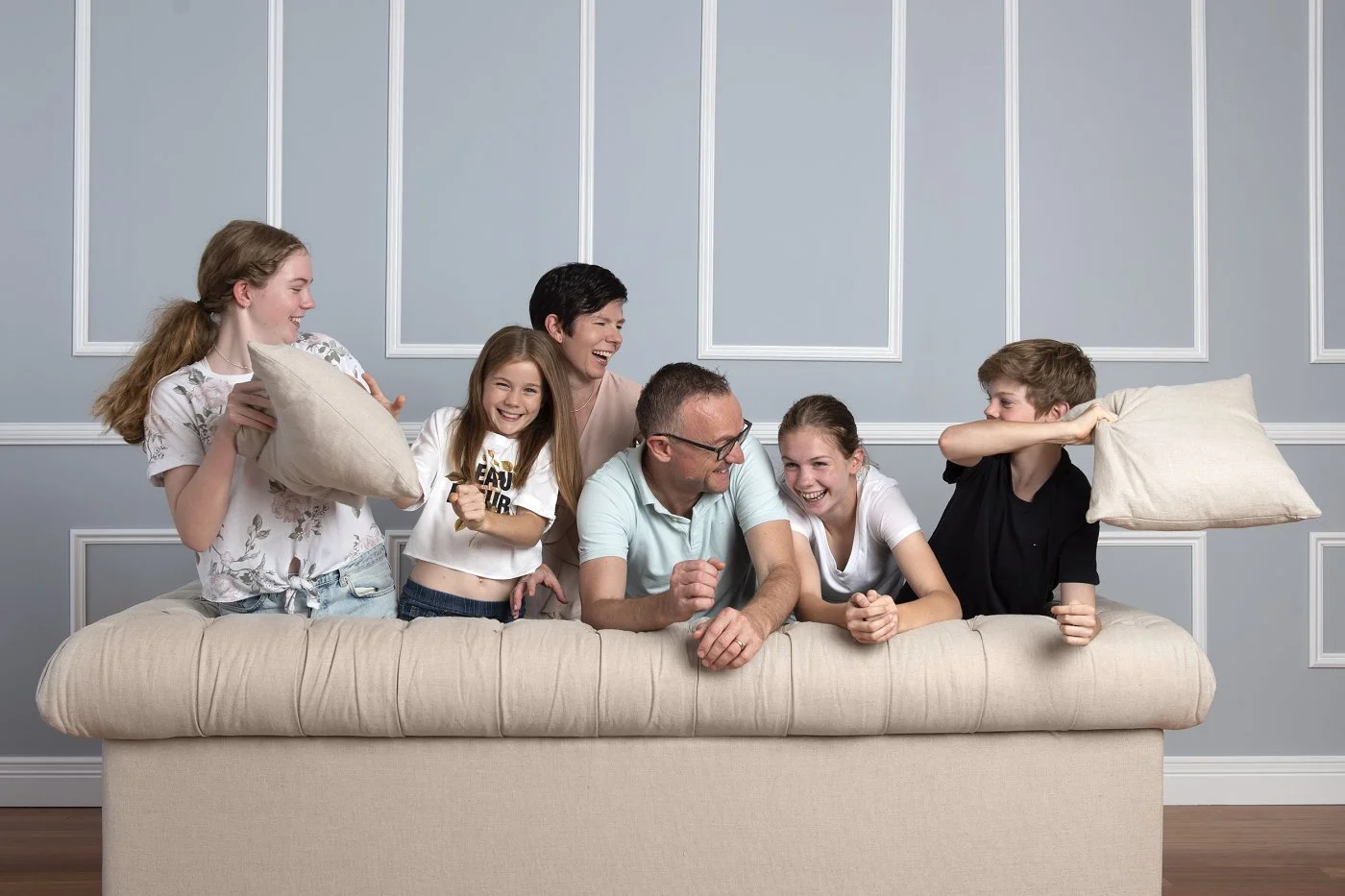
Are You Really Present with Your Children?
How often are you fully and completely present when you are with your children? One of the greatest gifts we can give to our children is to be fully present with them. In the times we live in, this can often be a big challenge.
Are You Really Present with Your Children?
How often are you fully present when you are with your kids? Not just in the same room. Not just supervising homework while scrolling your phone. Actually present. Listening. Engaged. Focused entirely on them.
If you are honest with yourself, it is probably less often than you would like. And that is not a criticism. It is just the reality of being a parent in a world that never stops demanding your attention.
I have three kids. When they were little, I was running my photography business full time, managing a household and trying to be a decent partner on top of it all. There were days when I felt like I was everywhere and nowhere at the same time. Physically present but mentally running through tomorrow's to-do list while my child was trying to tell me something about their day.
It took me a while to realise that being in the room is not the same as being present. And that the difference matters more than I thought.
What "Being Present" Actually Looks Like
For me, the only way to genuinely be present with my kids was to create what I called "time alone" with each of them. Not family time where everyone is together and chaos reigns. Individual, one-on-one time where I did whatever they wanted to do.
During that time, I did not answer the phone. I did not fold laundry or empty the dishwasher. I did not think about client emails or what was for dinner. It was their time, and they had my full attention.
Some days it was half an hour. Some days it was longer. The length mattered less than the quality. What mattered was that for that window of time, my child knew they were the most important thing in my world.
What Happens When Kids Do Not Get Your Full Attention
Children are perceptive. They know when you are distracted. They know when you are half-listening. And they interpret it in a way that is hard to hear: they think they are not important to you.
That is not what you mean, of course. You are distracted because you have a hundred things to do and not enough hours. But your child does not see your to-do list. They see a parent who keeps looking at their phone, who answers every call, who says "in a minute" and then forgets.
When kids do not get focused attention, they find other ways to get it. Some chatter nonstop, trying to hold your attention by sheer volume. Some act out, fighting with siblings or pushing back on chores, homework and bedtime. Some go quiet and stop trying altogether. None of these are bad behaviour. They are a child communicating a need the only way they know how.
My Own Experience Growing Up
My mum was always busy when I was a kid. She was juggling three children and working part time, and it felt like she never had time to just be with me. She never asked about my thoughts or feelings, or how things were going at school. She never played with me or just hung out with me.
I do not say that to criticise her. She was doing her best with what she had. But I remember how it felt. And when I became a mum, I was determined to do it differently. That is where the "time alone" idea came from. I did not want my kids to grow up feeling like they were not important enough for me to stop and pay attention.
It Gets Harder as They Get Older
When your kids are little, they want your attention constantly. The challenge is finding the energy to give it. But as they get older, the dynamic shifts. My kids are busy now with their own friends, schoolwork and screens. There are days where I am the one trying to get their attention, not the other way around.
This is where the habits you build when they are young pay off. If your child has always had that one-on-one time with you, they are more likely to keep talking to you as teenagers. Not about everything. But about enough. The connection you build in those early years becomes the foundation for the relationship you have with them later.
Think About How It Feels When Someone Really Listens to You
When was the last time someone gave you their complete attention? Looked you in the eyes, listened to what you were saying, and did not check their phone or look over your shoulder? It feels incredible, does it not? It feels like you matter.
Now think about how rarely that happens in everyday life. Most conversations are half-attention at best. We are all guilty of it.
Your child feels the same way you do when someone truly listens. And they feel the same way you do when someone does not.
You Do Not Need to Be Perfect
This is not about guilt. Nobody can be fully present every minute of every day. You have a life to run, meals to cook, a house to manage and probably a job on top of that. The goal is not perfection. The goal is intention.
Thirty minutes a day of genuine, focused, one-on-one time with your child is enough. Put the phone in another room. Turn off the television. Sit with them and do whatever they want to do. Ask them questions and actually listen to the answers. Let them lead.
It does not have to be elaborate. It can be a walk around the block. Drawing together. Kicking a ball in the backyard. Lying on the couch while they tell you about a game they are playing. The activity does not matter. Your attention does.
They Grow Up Fast
I know this sounds like a cliché, but it is true in a way that only hits you when it is happening. One day you are settling a newborn at 2am and the next you are dropping a teenager at a party and hoping they text you when they want to be picked up.
The version of your child that exists right now will not exist for long. The things they are excited about, the way they laugh, the stories they tell you at bedtime. All of it is temporary. And the only way to hold onto it is to actually be there for it.
You have an opportunity every single day to give your child something that costs nothing and means everything. Your full, undivided attention. Even if it is just for half an hour.
Do not miss it.
Kate x


Top 5 Settling Techniques for a Newborn
Your new little person has arrived safely, you’ve left hospital where they were sleeping perfectly and now you can’t get them to sleep...
As a mum, I have been there so i totally understand; With my firstborn I remember days and days of worrying that he wouldn’t sleep and spending hours settling him to sleep only to wake up 20 minutes later!
These are my Top 5 techniques that really made a difference for me:
Your new little person has arrived safely. You have left hospital where they were sleeping perfectly, and now you cannot get them to sleep at home. I have been there. With my firstborn, I remember days and days of worrying that he would not sleep, spending hours settling him only to have him wake up 20 minutes later.
These are the five techniques that made the biggest difference for me.
Make Sure They Have Had a Really Good Feed
When you are breastfeeding, it is hard to know when your baby has had enough. A warm, cosy baby is much more likely to fall asleep mid-feed, which means they wake up hungry 20 minutes later and you are back to square one.
I had a few tricks that helped me keep feeds going longer. I used to take their clothes off before feeding so they were not too warm and comfortable. I kept the room a little cooler than usual. And I tickled their feet while they fed. All of these things helped keep them awake long enough to get a full feed, which meant longer sleeps afterwards.

Burp Them Properly
I remember thinking in the early days that if they had not burped after a few seconds, they were not going to. I was wrong. It can take a few minutes, and the technique matters. I found holding them upright on my shoulder and patting their back worked best for me. My sister used to lie her babies across her knees and pat. Every baby is different, so try a few positions until you find what works for yours.
A baby with trapped wind is not going to settle no matter what else you do, so this step is worth the patience.

Wrapping is Worth the Effort
My babies all had a strong startle reflex. Every time they stirred, they would startle themselves awake, which meant nobody was getting any sleep. I quickly worked out that wrapping firmly made a huge difference.
There are lots of wrapping techniques, so find the one that is easiest for you. The key is to wrap firmly enough that they cannot wriggle free too easily. If you have a summer baby, use a lighter wrap so they do not overheat. These days there are also some great sleeping bags that do the same job without the wrapping.

Do Not Keep the House Too Quiet
This is one of the best things I did. I never closed the baby's door, and I always had the radio or TV playing in the background. My babies got used to falling asleep with normal household noise around them, which meant they were far less likely to wake at a sudden sound.
I had a friend who insisted on total silence when her kids were sleeping. She would usher us into the backyard, we had to whisper, and she had signs all over her front door not to ring the doorbell. Her babies never slept well. I think there is a lesson in that.
The bonus of background noise is that my kids used to wake up happy. I could hear them chatting in their cots, and I did not need to rush in the second they stirred.

The "If All Else Fails" Option
Some days, nothing works. You have fed them, burped them, wrapped them, and they are still not sleeping. On those days, I used to put them in the car and go for a drive. There are very few babies who are not settled by the movement and the noise of a car. It can guarantee a decent sleep and saves you from dealing with an overtired baby for the rest of the day.
No guilt required. Whatever gets your baby to sleep is the right answer.
Kate x

Easy Meals for Fussy Toddlers: Quick, Healthy Recipes You Can Make Together
Healthy, Cheap and Easy Meals for Fussy Toddlers
As mums I believe we either get one of 3 types of eaters with our toddlers;
The Toddler that eats everything!
The toddler that HATES any form of fruit, vegetables or healthy food of any kind.
The ONLY plain food toddler!
There are some tips as a mum for some healthy ideas
If you have a fussy toddler, you already know the drill. You spend time cooking something nutritious, put it in front of them, and they look at you like you have just served them a plate of dirt. It is exhausting.
After three kids of my own and years of chatting with mums at sessions, I have learned that most toddlers fall into one of three categories: the one who eats everything (lucky you), the one who refuses anything green, and the one who will only eat plain food. If yours is in category two or three, these tips and recipes might help.
Give Them a Choice
One of the simplest things you can do is let your toddler choose. Not from the entire fridge, but from three options you have already decided on. "What does your tummy feel like for dinner? We have this, this or this." It gives them a sense of independence and makes them more likely to actually eat what ends up on the plate.
Cook Together
Meals you make together are not just about food. They are bonding time, education and conversation all rolled into one. My kids always gave me one-word answers about their day at childcare, but put them next to me at the kitchen bench with something to stir or mash and suddenly they would not stop talking. It breaks down that barrier because they are focused on spending time with you rather than running off to the next toy.
Use Their Interests
Whatever your child is obsessed with right now, use it. Monster trucks, unicorns, Bluey, dinosaurs. Unicorn pancakes with a banana horn. Dinosaur toast with vegetable claws. If it is too fiddly to make from food, grab a cheap plastic toy from the party section and pop it on the plate. It sounds silly but it works.
Three Quick Recipes to Try
Banana Pancakes
Ingredients:
1 x Ripe Banana
1 x Egg
2 x Table spoon Self raising flour
Mash the banana until smooth, whisk in the egg and flour, let it sit for five minutes, then cook spoonfuls in a non-stick pan over medium heat for one to two minutes each side. Done. Fruit disguised as a treat.
Pirate Ship Tacos
Ingredients:
Old El Paso - Soft Tortilla bowl
500g x Mince
1 x Shredded Cheese bag.
2x Tomatoes
1x Iceberg lettuce
1 x taco seasoning
1 x pack of little flags ( pirate flags, princess flags - relate to your toddlers interest - usually found in party or baking section at the grocery store.)
Set up five small bowls and get your toddler to separate the ingredients into each one. It will be messy, but that is half the fun. Let them build their own taco, top it with a little flag from the party section at the shops, and call it a pirate ship. Make one for yourself too.
Dippy Eggs and Soldiers
Ingredients:
1 x Egg ( per child)
2 x toast.
Boil the eggs for three to four minutes for a runny yolk. Toast the bread, cut it into long strips and let your toddler dip away. My grandma called them dunking soldiers and it is still one of the simplest meals that kids love.
You Are Doing a Great Job
Feeding a fussy toddler is one of the most frustrating parts of parenting. But if they are fed, happy and loved, you are nailing it. Try one of these this week and see how you go.
Kate x